
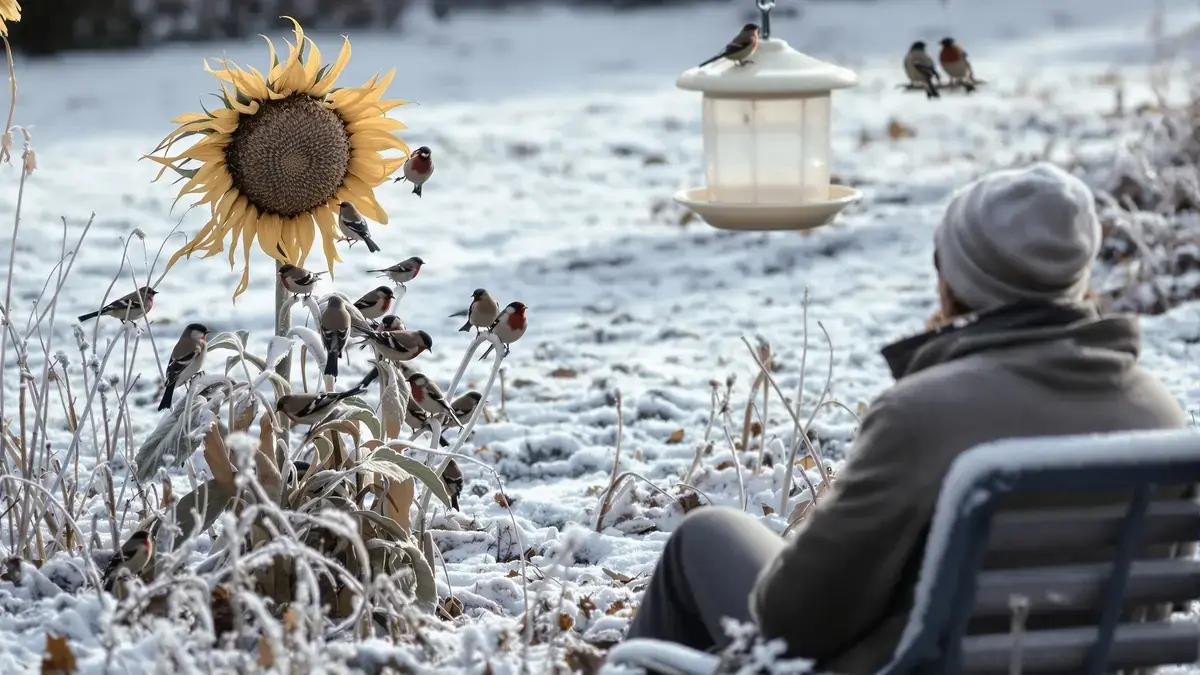

Mid-winter brings its particular quiet: a garden bench dusted with frost, trees silent, while a handful of fragile stems sway at the border. Amid empty feeders and frayed hopes, something unexpected stands bright against the faded landscape—a golden disk rising defiantly above dull ground. Its presence seems mundane, almost overlooked, yet the number of winged visitors it attracts soon challenges that impression. More than decoration, this plant offers something irreplaceable on cold mornings.
Sunflowers Dominate While Feeders Wait
A plastic feeder swings, untended, on the edge of a yard. Fat balls hang, gathering moisture, sometimes ignored by the very creatures they are meant to serve. The promise of busy birds remains unfulfilled unless there is something more compelling nearby—a living, self-sustained resource. Through the winter, as food sources wither or disappear, those golden flowers, now stooped and ragged, quietly become beacons for the feathered and famished.
Sunflowers, well known for their summer spectacle, offer a different gift when flowers fade. Their broad heads tilt earthward, bracts curling to form a shelter. Where the blooms sat, dense seed clusters remain, protected from the worst of rain and frost, clean and dry. No synthetic feeder replicates this kind of security. And the birds seem to know: they flock not to plastic, but to nature’s own grain silo.
A Feast Designed by Nature
During scarcity, instinct leads birds to where energy is concentrated. While commercial seed mixes fill shop shelves, much of their content ends up wasted—rejected fillers, spoiled by weather or pests. Birds, sorting through husks and unwanted kernels, scatter debris that attracts trouble on the ground. The simple stalk of the sunflower solves this in one sweep: seeds stay fresh, elevated, and as each is plucked, it delivers the full charge of fats, proteins, and minerals necessary for survival.
On frigid days, a black oil sunflower head brims with possibility. The thin shells split easily, even for smaller beaks. The rich oil provides warmth through cold nights, while high protein supports recovery and strength. Every peck is a calculated act of nutrition, with none of the disease risk or contamination found in exposed, human-made feeders.
Bird Behavior Around a Golden Table
A quiet spectacle unfurls as birds gather. Tits hover acrobatically, clinging to the side of the seed head, snatching a single seed and darting away to open it. Finches and siskins perform more deliberate foraging, sometimes lingering to pick at the densest patches. Nuthatches descend upside down, adept at prying loose the toughest seeds. Sparrows wait below for fallen kernels, making use of leftovers. Each bird finds a niche, shaped by instinct and physical design, making the sunflower’s bounty last longer.
The diversity is striking. Not just one or two regulars, but flashes of color and subtle differences in movement—the result of an ecosystem responding to a well-placed sunflower.
Effortless Renewal, Minimal Impact
Planting a sunflower does not require meticulous planning or expert care. A patch of ground, direct sunlight, and a scattering of black-seeded varieties is enough. Once established, the plants grow tall and strong with little intervention. Through autumn and into winter, their heads stand sentinel, seeds ripening and waiting. There is no waste, no excess, and as old stalks break down, some seeds will return to the soil, germinating when weather softens.
Instead of constant cleaning, refilling, and defending against squirrels and mold, gardeners find themselves spectators—watching cycles replace labor, and birds benefit from a resource that asks almost nothing in return.
Beyond Utility: An Ecological Shift
Leaving sunflower stalks through winter does more than help birds. Insects burrow beneath the stems, small mammals find shelter, and the soil itself is quietly replenished. It is an act that moves away from consumption and control, toward something closer to observation and respect. There is a humility in letting the natural process set the pace.
As seasons turn, the simple act of planting sunflowers becomes a gesture of participation—joining food chains and cycles, not bypassing them. The boundaries between garden, wildlife, and human effort soften. The result is a garden that is not only more alive, but more connected.
In this approach, sunflowers move from trivial ornament to silent anchors for biodiversity. What seemed insignificant reveals itself, over frost and thaw, as the center of a drama both ancient and quietly essential.
The winter may be quiet, but at the edges of fields and lawns, a golden sentinel proves that simplicity can still shape the rhythm of survival.
