
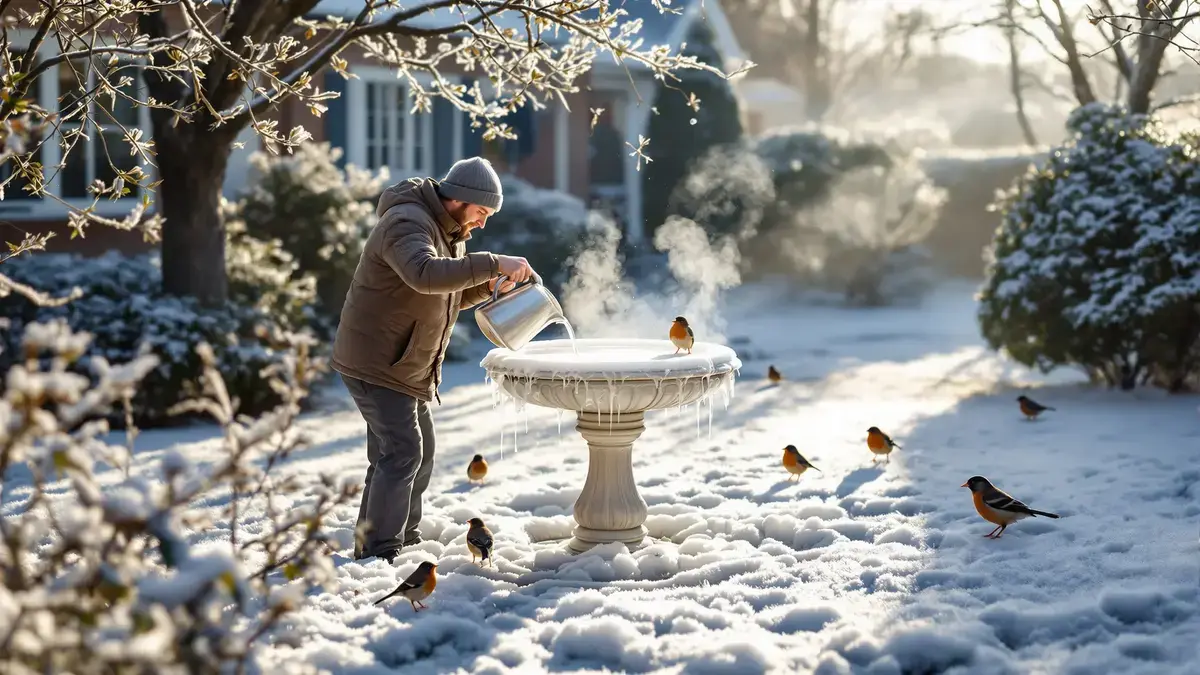

Frost traces its way across the garden, coating the birdbath in a quiet shimmer. Out the window, the world feels locked, frozen into stillness. Yet, when the kettle hisses, there is a decision waiting: a small moment to step outside, where the garden’s only accessible water may be the difference between struggle and survival for the birds that linger all winter.
Low sun and the silent visitors
Robins and sparrows keep close to hedges, their feathers puffed for warmth. Blackbirds hop over frosted grass. As puddles turn into glassy plates and gutters stiffen along the roof edge, every open drop of water disappears. The garden becomes a dry land, cut off from what birds need most—liquid water.
A birdbath, half-forgotten in a quiet corner, suddenly matters. Not just for drinking, but for preening—the way a bird cleans and re-lines its feathers, holding the warmth in. Without that water, insulation is lost. The small habit of maintaining a garden birdbath grows into a quiet responsibility, unnoticed by most.
Thirty seconds, every morning
It is not a complicated ritual. While coffee brews or slippers brush the doormat, a glance and a walk are enough. The birdbath is shifted—nudged into the sunniest, most sheltered spot. A fence or shed wall can shield against sharp winds, but the basin must stay away from lurking corners where a cat might wait.
Water poured nearly to the brim slows the freeze. The thicker the layer, the longer it takes for cold to seize it. A dark surface—perhaps a stone placed in the basin, the shadow of slate under the bowl—draws sun, holding fleeting warmth.
Keeping water open in the coldest weeks
Some mornings, a thin skin of ice will form, brittle and stubborn. No need to reach for a kettle of boiling water, nor to shatter the ice—both can crack the bowl or shock its surface. Instead, a container of hot water sits gently atop the ice, releasing its warmth. The ice softens. It lifts away, soft and harmless.
There are no gadgets humming in the background, no heated wires or expensive contraptions guarding the water here. Instead: consistency. Check once a day, refill when needed, clean out old water and scrub the basin each week. Less than a minute daily, and the reward arrives silently, feathers bright and bodies lighter.
A haven in frozen weather
From the kitchen window, movement catches the eye—a robin perches, sips, leans forward to plunge its wings. Blackbirds follow. Where nearly everything remains locked and still, the birdbath becomes a focal point. It is a simple oasis, a holdout against winter’s grip.
Neglect is easy. Survival, for these birds, is not. By carving out a habit—thirty seconds, repeated—a small patch of the world becomes more than just a cold garden. It becomes part of something vital and resilient, a link in the winter chain that too often goes unnoticed.
Quiet infrastructure for life
These micro-actions, repeated daily, do more than offer water. They echo the patterns of care and adaptation that carry wildlife through the hardest weeks. With almost no effort, a winter spent tending the birdbath transforms a frozen yard into a winter refuge.
So, while most of the world sleeps under frost, it is the understated, nearly invisible habits that build survival. A simple gesture, performed in passing, shapes the lives around us, even as ice presses against the panes and the earth holds its breath.
In the end, it is not the scale of the action but its reliability that counts. The birdbath, looked after without fuss or attention-seeking, becomes a quiet scaffold for the noisy, fragile lives that depend on it—reminding us, as winter deepens, of the subtle ways we sustain the world just beyond the glass.
