
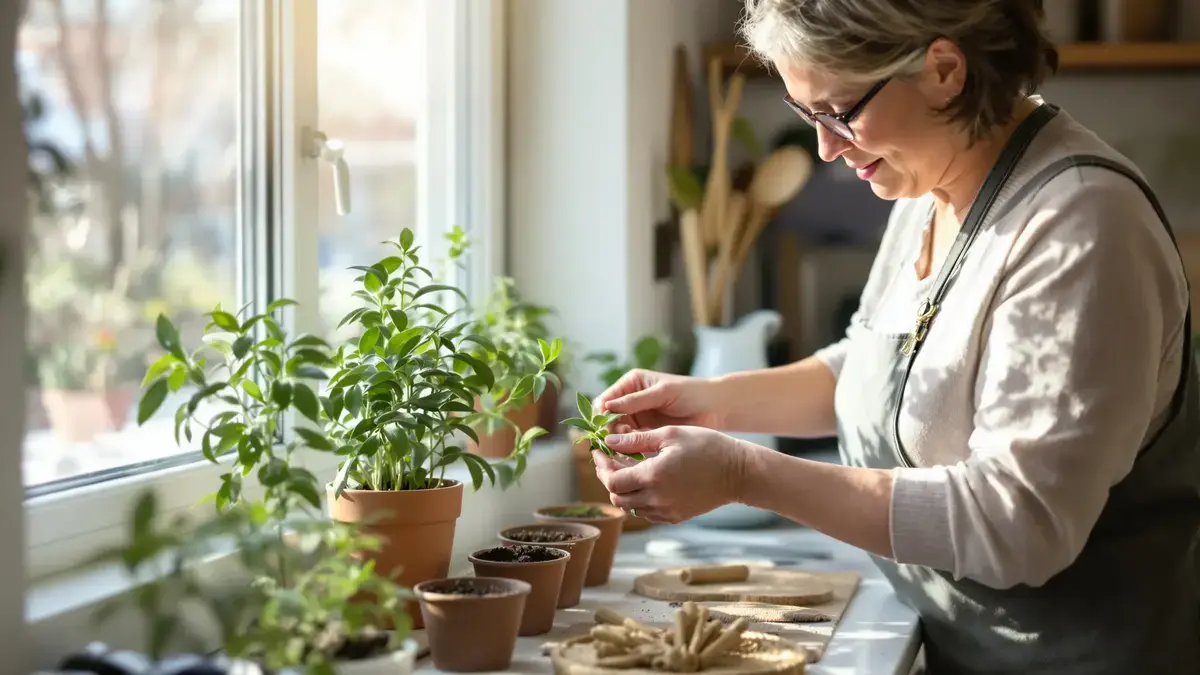

On a quiet windowsill, winter light falls across grey-green leaves. The garden outside seems asleep, soil cool and undisturbed. Yet, for those who look closer, February reveals a discreet vantage: a chance to multiply the garden’s scents for months ahead. Neglecting a single step now can shrink the future palette of fragrances—though the gesture is almost invisible, and the solution sits within arm’s reach.
A Routine Overlooked
Most gardeners are eager for color or the first hints of warmth, but few pause for the subtle work that shapes a garden’s character. In fact, 90% of gardeners forget to take cuttings from aromatic plants in late winter. The result is a quieter, less varied fragrance in summer, when the air could carry far more.
Along the edge of the kitchen, pots gather. Soil, a little dry. Sage—Salvia officinalis—waits, often ignored, its soft leaves holding promise.
Sage: The Hidden Cornerstone
Common sage is more than a kitchen herb. Its leaves, densely textured and strongly scented, thrive in drought and attract pollinators early. This plant, a tough presence from Mediterranean hillsides, has adapted to survive on little water and sparse soil.
Indoors, while the world outside is cold, sage can be multiplied with minimal effort. February is ideal—not despite the season, but because of it. Old stems, neither new nor fully woody, hold hidden reserves to drive new roots. Just before spring awakens the garden, sage’s quiet energy is ready to be tapped.
The Art of Winter Propagation
The process plays out in the space of a morning. Select a stem—8 to 10 centimeters long, not yet flowered. Its lower leaves slip away between your fingers, leaving a tuft at the top to catch the light and keep the plant breathing.
A simple mix of potting soil and river sand gives the cuttings a fresh, fast-draining bed. The stems slip halfway into the earth, each one upright and alert. Gentle water dampens but does not drown. A clear covering, plastic perforated for breath, shields the foliage while letting in brightness.
Placed on a window ledge, the mini-greenhouse holds steady at around 18°C. Humidity is checked regularly, covers lifted just enough to prevent rot. In three or four weeks, most cuttings will root, quietly multiplying the garden’s foundation.
What Follows Frost
By the time hard frost gives way to uncertain spring, the propagated sage will be sturdy enough to plant outdoors. Well-drained soil, open to daylight, suits it best. Planted alongside other Mediterranean herbs—rosemary, thyme, mint—a patch of aromatic plants demands little water, even under the summer sun.
Rows of sage release their scent whenever the garden is brushed by rain or wind. Bees circle, finding early nectar when other blooms still hesitate.
A Quiet Shift
Skipping this February window narrows what the garden will become. The act is simple—one session, some cuttings, a handful of pots. Yet it expands the choices for gardeners, creating rich, scented borders that last. Propagation is a background gesture, one that turns the ordinary cycle of winter into an opening for abundance, all from the edge of the window.
