
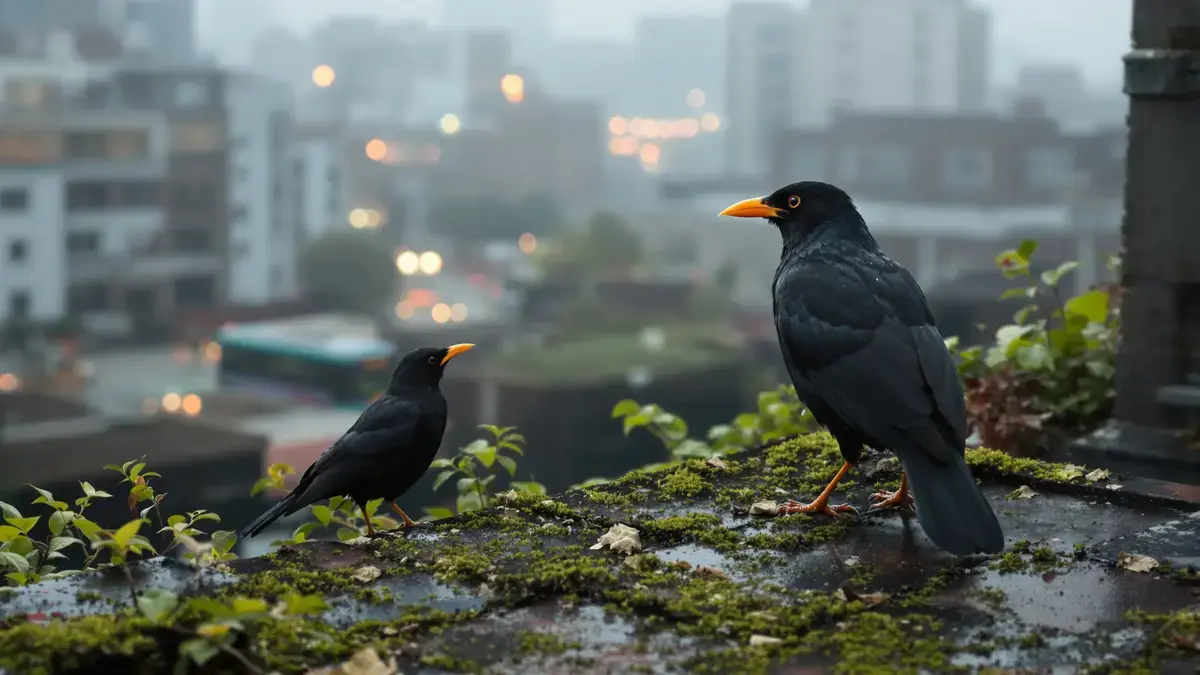

On a damp morning, the first thing to break the blanket of silence is often a thread of music weaving down from a rooftop or thicket. The sound belongs to a bird so familiar it tends to go unnoticed, even as it claims gardens and city corners as its own. Underneath the blackbird’s glossy stillness, there’s far more variation and invention than most would guess—its presence hints at quiet transformations happening right where we live.
Rooftop Intruder, Forest Legacy
The blackbird circles a patch of mossy tiles, pausing to look out over the waking city. This is not its ancestral home. For centuries, the blackbird thrived as a forest dweller, slipping through shadows and foraging among tree roots. That changed unexpectedly in the nineteenth century. Seeking food and shelter, it gradually colonized the expanding cities, where winters proved gentler and meals easier to come by. Over time, urban blackbirds started behaving differently from their woodland relatives, showing less fear, learning to cope with rumbling buses and shouts, inventing a style all their own.
On the Edge of Camouflage and Boldness
A quick flash—a male blackbird lands near a puddle, plumage so deeply black it seems to draw in the light. The orange bill and sharp ring around the eye are almost glowing. Nearby, a female blends into the shrubbery, brown and understated, perfect camouflage as she tends a well-concealed nest. The difference in their coloring is more than aesthetics; it reflects each bird’s role. The male’s brightness plays a part in attraction, the female’s earthiness in safety. Juveniles, difficult to spot, resemble their mothers until, little by little, some begin to darken and reveal their future colors.
City Songsmiths
The street quiets a moment before dawn. Somewhere, a blackbird begins to sing—a loose, rich melody, spun with improvisation. No two blackbirds sound exactly the same, each drawing on a personal repertoire, sometimes weaving in fragments of other urban noises. In cities, these birds start earlier in the day, responding unconsciously to the artificial lights flickering through the leaves. Among birds, their song is one of the most elaborate, part art and part claim—a way to defend territory and entice a mate, carrying above the buzz of traffic and clatter of bins.
Territorial Drama in the Branches
Things are rarely as calm as they seem. Blackbirds are ruthless about boundaries, especially during breeding season. Fights and chases break out, a blur of wings as two males spiral through the air, or a sudden tapping against a window where a bird mistakes its own reflection for a challenger. Territory is everything: it means food, shelter, and a future for offspring.
Memory and the Rhythm of Food
Turn the soil on a bright spring day, and a blackbird will appear, its eye set on freshly exposed earth. What looks like chance is often the result of memory. These birds are tuned to subtle changes—knowing which garden yields the earliest berries, which patch of lawn reveals worms after rain. Some return again and again to places that once held easy food, guided by a spatial sense surprisingly refined for a backyard visitor.
Eclectic Diet, Subtle Influence
Spring brings out hunters: blackbirds scurry over grass for insects, lift snails in their beaks, collect spiders for young mouths waiting in the dense green. By autumn, diets shift. Berries replace grubs, fruit replaces worms. This opportunistic appetite keeps them present even as seasons roll by, and their taste for invertebrates brings a quiet boon to gardens beset by pests.
Repeat Performers
Somewhere deep in a hedge, a nest comes together from twigs and mud, shaped by determined beakwork. A female settles in, disappearing beneath layers of green. With luck, three to five eggs appear; in a good year, there may be several broods, one after another. Both parents take turns at the endless ritual of feeding, and fledglings drop from the nest while still relying on help—a family in motion through much of the warm season.
The Movers and the Stay-Behinds
Winter does not send all blackbirds fleeing. In temperate landscapes, many remain through the cold, favoring neighborhood gardens and parks. Others undertake long journeys from the north or east, drawn by milder air. This fluid migration brings together residents and newcomers; city parks become shared spaces, full of birds with different pasts.
Evolution on the Sidewalk
City blackbirds are not just living in a changed world—they are changing themselves. Studies point to altered reactions to stress, a willingness to nest earlier, and a general resilience that outpaces their rural kin. Each generation seems to find new ways to endure noise, lights, crowds, and shifting rhythms brought by human invention.
A Signal in the Branches
Seeing a blackbird poised above a tangle of brambles, or listening to a song ring out from an overgrown corner, speaks to more than a single life. Where blackbirds thrive, the landscape usually offers dense cover, fruitful bushes, moist, living earth. Their absence, though, marks a loss—the subtle signs of a changing environment. In so many ways, the blackbird is a messenger for the balance and adaptability of nature close at hand.
As the day fades and the last notes drift overhead, the story of the blackbird remains one of resilience quietly on display—never quite the same from one rooftop to the next, always ready to improvise with whatever the moment provides.
